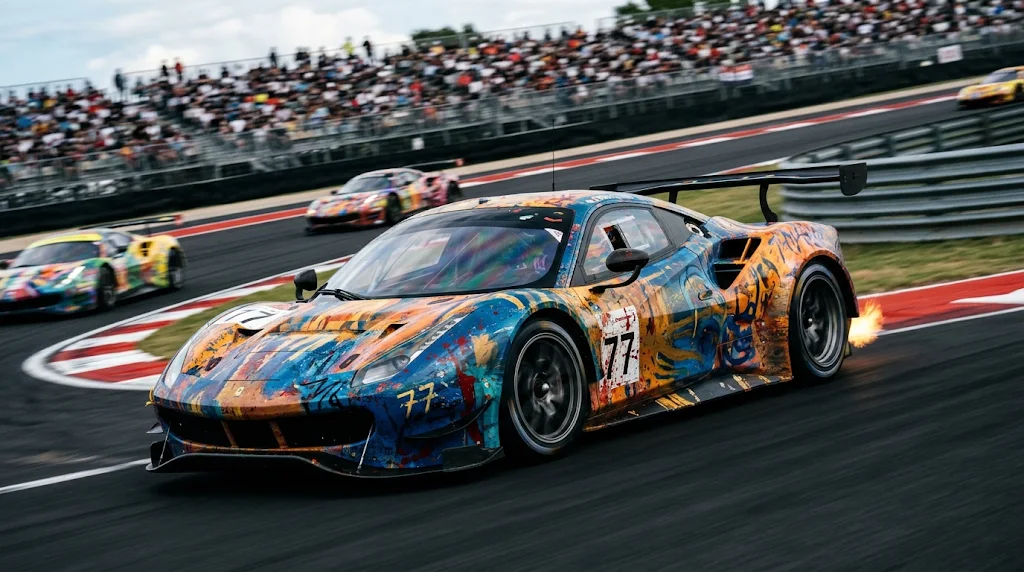
If you walk into a gallery, you expect silence, white walls, and time to look. If you walk into a paddock, you expect noise, heat, and no time at all. Yet both places ask you to do the same thing: look closely, and feel something before you understand it.
One Art World describes itself as an international platform dedicated to connecting artists, cultural initiatives, and creative communities from around the world, with a mission to promote artistic expression and cultural dialogue on a global scale. That is also, without knowing it, a perfect description of a race weekend.
This is not an article about lap times. It is an article about seeing motorsport the way an art curator would see it: as colour, form, light, and movement.
1. The Gallery Walk Starts in the Paddock
In the art world, exhibitions are found through a calendar. One Art World takes exhibitions, receptions, and events and presents them in an art events calendar, so visitors can find what is happening in their area. Motorsport needs the same habit.
A season is not one race. It is a calendar of exhibitions that move. Formula 1 in Monaco is a different exhibition from Formula 1 in Monza. A rally in Finland is a different exhibition from Dakar in the desert. The car is the same. The light, the surface, and the crowd are different.
A season is not four races. It is practice at nine in the morning, qualifying at three, a sprint nobody expected, and a rally stage running while you make dinner.
That line from Automotive Digest is the curator view in one sentence. You do not see the whole exhibition by arriving at 3pm on Sunday. You see it by walking through the rooms, one by one.
2. Livery as Painting
A livery is not advertising. It is painting at 300 km per hour.
Think of the great liveries as you would think of paintings. The Gulf blue and orange is not just a sponsor colour. It is a composition, two blocks of colour that stay readable at speed, in rain, in dust, at night. The Martini stripes are a rhythm, a line that moves even when the car is parked. The classic Lotus black and gold is chiaroscuro, dark body, bright edge, shadow and light.
Modern liveries are harder. They have to work on television, on a phone, on a tiny thumbnail, in the rain. That is why the best designers think like graphic artists, not like engineers. They ask: what does this car look like from 200 metres, from above, from the side, in a photograph?
When you watch your next race, try this curator exercise. Mute the commentary for two minutes. Watch only colour. Which car can you find in a pack of twenty? Which livery survives the spray? Which one disappears? That is painting, tested by speed.
3. Aerodynamics as Sculpture
If livery is painting, aerodynamics is sculpture.
A Formula 1 car is not designed to be beautiful. It is designed to be fast. Yet the result is beautiful because every curve has a reason. A front wing is a line. A floor is a volume. A rear wing is a gesture, a hand pushing air down.
In a museum, a sculpture is made to be walked around. A race car is made to be seen from one angle at a time, and never for long. At the start, you see the front. In a corner, you see the side. On a straight, you see the rear, shrinking. The sculpture changes as you move, or as it moves past you. That is why photographs of race cars often feel more sculptural than the cars themselves. A photograph freezes the movement and lets you walk around the form in your mind.
The same is true for rally cars. A rally car is a sculpture that has been hit by a landscape. Mud, dust, broken lights, dented doors. In a gallery, we would call that patina. In rally, we call it a stage.
4. Night as Installation: Le Mans
If you want to understand motorsport as contemporary art, watch Le Mans at night.
During the day, Le Mans is a race. At night, it becomes an installation. Headlights in the forest, brake discs glowing orange, pit lane as a white cube, the sound of engines as a low, constant drone. You do not watch it. You stand inside it.
Artists who work with light would recognise this immediately. The night stint is not about lap times. It is about duration, about staying awake, about watching light move through darkness for hours. It is the closest motorsport gets to a performance piece.
My curator rule for Le Mans is simple. Watch the start for colour. Watch the night for light. Watch the finish for emotion. Three acts, like a play.
The planning page for that night is endurance guide for watching Le Mans like an installation
5. How to Watch Like a Curator
A curator does not try to see everything. A curator chooses, frames, and lets the rest go. Here is how I watch motorsport now, after years of trying to watch everything and enjoying nothing.
- Pick one exhibition per week. One race, one series, one story. Not five.
- Arrive early. Watch qualifying, or the first stage, or the parade. The opening room sets the tone.
- Look, then listen. Watch two minutes without commentary. Then turn the sound on. You will hear more.
- Save one image. One photograph, one screenshot, one clip. That is your catalogue for the week.
- Leave space. Do not watch a second race in the background. A gallery with two exhibitions on top of each other is noise.
Motorsport is fragmented, and that is part of the problem for a curator. The site puts it like this:
No other sport is sliced up quite like motorsport.
One series is on one service, another series is on another, practice is here, qualifying is there. A curator solves this by making a list before the weekend, not during it.
Where to Watch This Exhibition
For Formula 1, I start with the full weekend guide, because it lists practice, qualifying, sprint, and support races in one place, not just the race. My page for that is Formula 1 viewing guide for the art of speed
For rally, I check what is live and what is highlights, because most stages are not 100 percent live, and that is normal. The direct page is:
https://www.automotivedigest.com/rally/
For the background of the blog, who edits it and why it mixes varied stories with motorsport, the direct page is:
https://www.automotivedigest.com/about/
Test any new feed the way the site recommends: on a race, not a trailer. Load it five minutes before a session. If the picture holds when the grid lights go out, it is good. If it dies, you saved your evening.
What the Art World Teaches the Race Fan
The art world teaches patience. You do not understand a painting in ten seconds. You understand it by standing in front of it, walking away, and coming back.
Motorsport is the same. You do not understand a championship in one race. You understand it by coming back, week after week, to the same cars, the same colours, the same drivers, and watching how they change.
A livery fades. A driver leaves. A team changes colour. A track disappears from the calendar. That is why the season feels like an exhibition. It is temporary. It will not be there forever. You have to be there to see it.
So this weekend, do not just watch the race. Curate it. Pick one exhibition, arrive early, look at colour, look at form, look at light, and save one image that will remind you why you came.
What is your favourite livery of all time, and why does it still stay in your mind?
Leave a Reply